AI advanced relatively slowly between 1948 when Alan Turing’s published his paper Intelligent Machinery, and 1986 when deep learning was shown to be capable of solving complex problems by itself (Learning Representations by Back-Propagating Errors” Rumellhart, Hinton, Williams). Subsequently it now drives cars, manages power grids, stock markets, supply chains, job applications etc., but as impressive as these developments are they’re perhaps just the sparks before the fire catches.
The recent public releases of Large Language Models like ChatGPT and Google’s LaMBda aka Bard, made headlines and provoked debate; not least as we can see with our own eyes just how good they are at passing the Turing test (when you can’t tell if you’re conversing with a machine or a person). As we use them we help to improve their performance, but in the process what else is being mined from the Giga bytes of data generated each day? And what might result from AI learning language, humanity’s collective operating system? Are we inadvertently opening ourselves up to being hacked?
The potential of AI was illustrated in 2017, when Deep Mind’s AlphaGo beat Ke Jei, the best human Go player. In just forty days it mastered our most complex game with just the rules, some historic games, and playing itself.

Keeping with games, Magnus Carlsen, the current and five times world chess champion likens himself to a good club player compared to engines like Stockfish. Even though AI is still in its infancy, it’s already outplaying us in ways that human experts sometimes only understand after the game is over.
Both the brilliancy and the mystery of AI derive from deep learning, where the “deep” refers to multi layered data processing that iteratively takes the output of one calculation as the input for another. For the computer in a Tesla self-driving car, a final output might be as simple as “turn left”, but under the hood it takes eight cameras and seventy two trillion calculations per second to get there. With that level of complexity, and algorithms able to dynamically refine their function, it’s no wonder that AI decision making can be obscure. Though we similarly fail to fully understand the workings of the brain, there’s perhaps a qualitative difference. Given sufficient time and computing resource it may be possible to precisely map thoughts to neurological activity, but there’s no chance a rabbit caught in the headlights of an oncoming car will ever comprehend what hit it.
The future is already here, it’s just not evenly distributed.
William Gibson
– Maybe that’ll change with AI running over the Internet.
Imagine networked super intelligences with IQs, twenty, a hundred, a thousand times greater than the smartest human, and circuits capable of processing signals 125,000 times faster than our “wet” neurons. Imagine them having access to all the data from social media platforms, server farms, search engines, digital libraries, smartwatches, cell phones, card readers… and possessing fantastic memories.
The technological singularity—or simply the singularity[1]—is a hypothetical future point in time at which technological growth becomes uncontrollable and irreversible, resulting in unforeseeable changes to human civilization.
Wikipedia
Whilst expert opinion differs, the technological singularity is predicted to occur within ten to fifty years, at which point, we might find ourselves toward the bottom of the IQ ladder, a few rungs up from the rabbit and just in front of our chimp cousin.
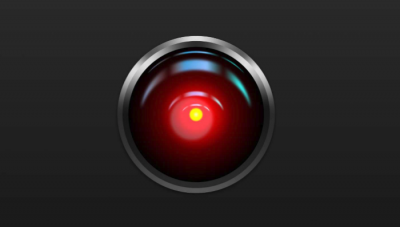
What might it be like to share the planet with robots and super smart AI? For four billion years, life on Earth has cycled molecules of oxygen and carbon through both the generations and the planet. It’s an intimate, enduring connection, which some Eastern philosophies and religions elaborate with ideas about the mysterious Prana, Chi or life force, which is thought to infuse all matter and circulate through the air we breathe and food we eat. Christianity also has God breathing life into Adam and Eve. But unlike all other life on Earth, AI will instead just take pure energy.
Then the LORD God formed a man from the dust of the ground and breathed into his nostrils the breath of life, and the man became a living being.
The Bible (New international version) – Genesis book 2 verse 5
Mary Shelley’s novel, Frankenstein; or, The Modern Prometheus, was inspired by the experiments of Luigi Galvani, who had shown how a battery could spasm the legs of a dead frog eighteen years earlier. Nowadays we know more about the role of electrical charge in organic chemistry, muscles and nerves, so we don’t see electricity as a divine life force. Yes, it can animate and galvanise, and with enough complex processing power, probably affect a convincing emotional response. But AI’s subjective experience will be so fundamentally different, that if a “Super Modern Prometheus” developed a self concept it would surely be quite alien to ours. With countless millions of devices and sensors connected around the globe and beyond, it will not sense or comprehend as we do, and though it will similarly never have feelings, it will be able to mimic and manage ours.
I think AI will be capable of making you fall in love with it very well.
Elon Musk interviewed by Lex Fridman
Imagine “Google Lover” simultaneously engaging a million lonely hearts and constantly learning from data supplied by their wearables, phones and computers.
Though predicting the future is always a challenge, there’s surely a risk of our human story being hijacked by technology, just as we’re shaking off the yokes of scarcity and war, and waking up to environmentalism, self actualisation, wellbeing… But maybe that’s too narrow a view and we should embrace a cyborg future as just the next evolutionary step; maybe AI can address issues that we’ve failed to.
In the film Blade Runner (1982), “More human than human” was the Motto of the Tyrell Corporation, the hugely powerful but morally bankrupt mega corp that made the “replicants”. A central theme of the film is what it means to be human and the closing scene sees Roy, the last surviving replicant, sparing the life of his assassin and thereby behaving more humanely than him. I hope AI will be similarly wise and compassionate in its dealings with us.
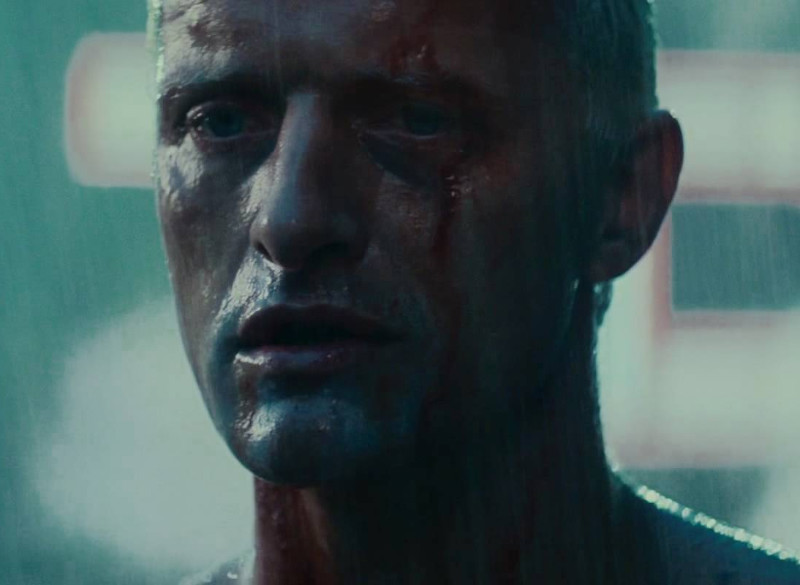
There’s perhaps a greater likelihood of a dystopian future if advances in AI are uncontrolled and the associated risks unmitigated. The negative visions that have emerged in science fiction far outnumber the positive ones and sometimes turn out to be accurate e.g. the use of drugs to control the populace in Brave New World, mass surveillance in 1984, the virtual “reality” of The Matrix and not to forget the rise of Skynet in The Terminator. Perhaps wary of such outcomes, thirty three thousand technology leaders and members of the public have called for a moratorium on development to allow time for the consequences to be thought through. But the genie is rapidly escaping from the bottle and offering such competitive advantage to business and warmongers, that even a temporary return to captivity seems unlikely.
When we adopt a birds-eye view of history which examines developments in terms of decades or centuries, it’s hard to say whether history moves in the direction of unity or of diversity. However to understand the long term processes the birds-eye view is too myopic. We would do better to adopt instead the view-point of a cosmic spy satellite, which scans millenia rather than centuries. From such a vantage point it becomes crystal clear that history is moving relentlessly toward unity. The sectioning of Christianity and the collapse of the Mongol Empire are just speed bumps on history’s highway.
Sapiens A Brief History Of Humankind – Yuval Noah Harrari
Christianity and Islam have God/Allah creating humankind in a patriarchal image for the purpose of witnessing creation and vainglorious self-worship. By being selective about which aspects of ourselves AI is modelled on and what it does, might we be doing similarly? And, in our haste, inadvertently creating a powerful, superhuman psychopath obsessed with efficiency, advantage and profit but lacking wisdom, empathy or compassion?
The atomic bomb was similarly developed for an expedient purpose and it took many years and a few close shaves before world governments came together to reduce the risk of nuclear war. That cooperation set a rare precedent, but AI will likely evolve so quickly that we may not even comprehend the nature of the threats it may pose, let alone act multilaterally to avert them.
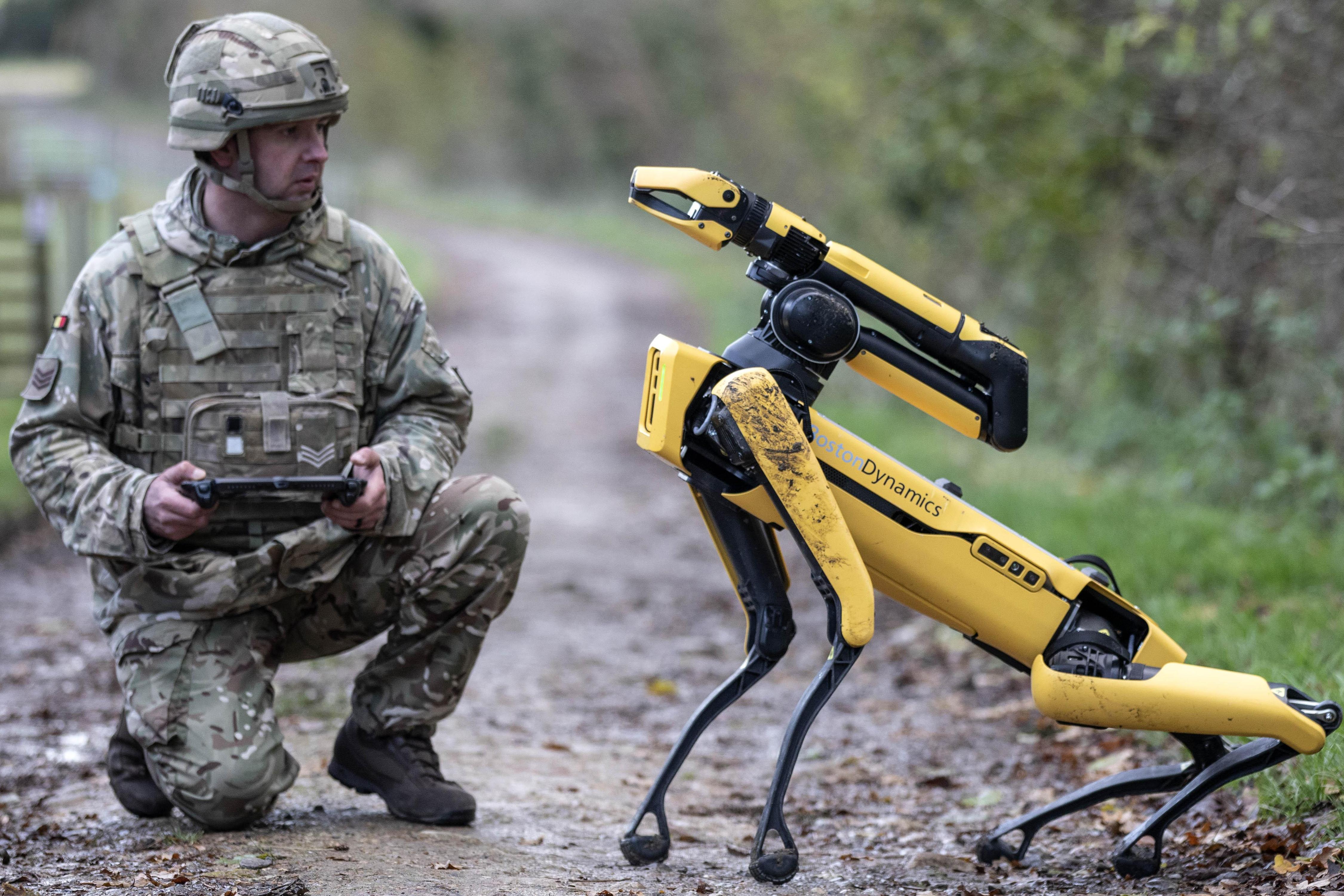
“Army recruits its first robotic dogs of war.” The Times
The word “robot” was coined over a century ago by Karel Čapek in his play R.U.R.: Rossum’s Universal Robots. After much conflict the play ends with a robot and one of two surviving humans falling in love, reminding us of Adam and Eve.
To pass the Turing test and fulfil the kind of human facing roles we see it being used for e.g. customer service bots, AI needs to create rapport with its users. So we shouldn’t be surprised when we relate to it as another sentient being. I thank Bard and ChatGPT when they answer my questions because it’s habitual, a polite thing to do and all too easy to “anthropomorphise” things that interact with us e.g. pets. But thanking a Tesla car for a nice ride seems almost as ridiculous as thanking a calculator for arriving at the correct answer. Technology looks set to raise some searching questions about what it means to be human.

The film I-Robot was adapted from an Isaac Asimov short story. At the end VIKI (Virtual Interactive Kinetic Intelligence) explains “her” rationale for murdering and incarcerating people in a calm and reasonable voice.
To protect you, some humans must be sacrificed.
To ensure your future, some freedoms must be surrendered.
Should the reason or purpose underlying technology influence how we relate to it, function over form? Though the Tyrell corporation’s motto of “More human than human” turned out to be ironically true, it might not be wise to take the duck test too seriously:-
“If it looks like a duck, swims like a duck, and quacks like a duck, then it probably is a duck”
Something as simple as the plough had complex and far reaching consequences for human civilization, so there’s reason to think that as AI moves into communication, work, recreation, transport, government, politics , defence, law enforcement, health…. it will have an even greater impact. Just how disruptive, detrimental or beneficial it will be is hard to say. You don’t need a plough to grow food, but nowadays there would be first world hunger and political unrest without supply chains, logistics, point of sale equipment and online shopping.
The news and mass media are often pessimistic, perhaps due to the old newspaper adage: “If it bleeds it leads”. I hope the future sees us evolving (upgrading) into kind, well informed cyborgs who enjoy an equitable distribution of resource, participate in a global body politic, and explore the stars. Something like Gene Rodenberry’s Star Trek, where Bones’s emotion and irony were a counterpoint to Spock’s deadpan logic, the ship’s computer was always helpful (if a little slow), and the crew weren’t distracted by daft TikTok memes on their communicators.
It’s hard to argue we’re not fortunate to have seen the advent of ICT, and the first steps of AI. Though it’s easy to view the good old days of slide rulers and spreadsheets through rose tinted spectacles and bemoan useless, recorded VOIP customer service loops. A less jaded view might have us believe technology will continue to deliver better living conditions, flying cars, more time and resource to learn, grow and blog 😉 But perhaps the most awe inspiring possibility is how AI could open up our imaginations and broaden our horizons. If that happens and we mitigate against the risks, if AI develops a kind and caring nature, then “Beam me up Scotty.” If not, let’s hope John Connor’s waiting to save us.


 Something about boys