You want to lose body fat. Your body fat’s maybe at 15%, you want to get it down to 12 0r 10% and the way you do that is by burning more calories than you eat.
Arnold Scwarznegger
It’s a simple formula, but a complex challenge. For those of us not on arctic expeditions or addicted to the gym, dieting is needed to achieve calorific deficit. Knowing about food types, caloric content, nutrition, metabolism… also helps, but perhaps the most important thing is knowing yourself and how to cope with hungry feelings.
For most of human history hunting an animal or the ripening of a crop brought a bounty of food that, without freezers or cans, had to be consumed quickly. Though agricultural made supply more reliable, harvests still failed and a pig that had been reared to fill the winter “hungry gap”, hardly sustained a family through to March. As a result we’ve evolved to take advantage of abundance by being able to quickly ramp up appetite, surge insulin and lay down fat. But for many of us, well stocked larders, freezers, eateries and the availability of most foods throughout the year, means abundance is frequently “on offer”.
We have a complex relationship with food that’s changed dramatically over the past hundred years. For those in economically privileged countries, surviving on too little is now less of an issue than surviving on too much.

So with metabolisms that have adapted over millions of years to cope with feast and famine (more often than not famine), and eateries replacing shops, it’s no surprise that obesity levels are rising in affluent countries.
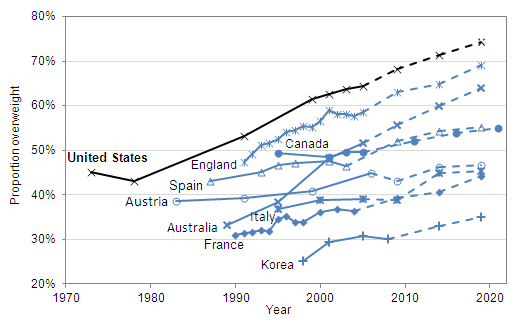
The Organisation for Economic Cooperation and Development
The first post about dieting, noted how my grocery shopping had changed, three months on, change has spread to other areas.
Recording weight over the months (helpful dieting tip), makes it clear that though the graph goes up, down and occasionally along, it’s the difference between the start and finish that matters. That and cultivating the behaviours needed to sustain progress.

Perhaps the change that’s made the biggest difference has been to eat simple, unprocessed foods in a 6 hour window between breakfast and lunch. Fasting, or barely eating, for the remaining 18 hours puts the body into ketosis when fat is burnt for energy (18:6 diet). Though eighteen hours sounds a long time to go without, you get used to it.
Fasting changes mental state, either positively (clear headed, euphoric) or negatively (headaches, weakness). If the former, there’s a positive feedback loop to offset the endorphins that come from eating. That said, like anything there can be downsides to extremes e.g. obsession, anorexia or becoming a diet bore.
Change has also spread to include a morning yoga routine. Being lighter helps with balance and suppleness which make a stretch first thing all the more enjoyable. All is then good, except for the occasional end result of my gut wringing every gram of sustenance from what passes through 😖.
This post is then about continuing the journey that began with an accident and incapacitation It’s been a positive and grounding experience in these disconcerting times. If having no control over one’s experience and watching the years drag things South is stressful, effecting positive change and treading more lightly is just the opposite.


 Something about boys