Rowing and living by the sea brings waves to mind almost every day. Here their collapse is viewed from an unusual variety of perspectives.
Alongside Freud, Carl Jung was instrumental in the development of psychoanalytic theory. Unlike his mentor, Jung challenged the primacy of the libido (sexual energy) as the principal human drive. He instead proposed that psychic energy served a range of purposes, not least of which was to drive inner spiritual growth and wholeness. Jung conceived this wholeness as the integration of the conscious and the unconscious that would differentiate the self from collective norms, stereotypes, and archetypes.
Jung also thought that this was most likely to be achieved during the “afternoon” of one’s life, when, after three score years or so, the journeys of love, parenting and work were. drawing to an end and there was time to turn inwards, contemplate and find meaning. Jung called this process of integrating one’s experience and nature into a truer version of oneself “individuation”.
Individuation does not isolate, it connects.
C. Jung
A wave begins when the wind catches the surface of the water, a micro disturbance that grows and travels across the ocean until it breaks upon the shore. It might be thought of as a vector with a limited lifespan. Though there are many similar waves, no two are the same. When one approaches its destination, it rises up to reveal its final form, only to collapse back in upon itself. Similarly the philosopher Martin Heidegger believed that Dasein (human existence) can only break free of everyday life, the “they-self” (das Man), by confronting its uniqueness in the face of inevitable death.

Collapsing the wave function (Ψ) is a term from quantum theory which is the result of the Measurement Problem, the conundrum of how the properties of particles seem to “exist” in numerous states, up, down, here, there (superpositions), until they are observed.
…anything that is massless has to travel at the speed of light.
Brian Cox referring to Einstein’s theory of Relativity
Schrödinger concocted his famous feline thought experiment to illustrate the absurdity of something being simultaneously both alive and dead until it is witnessed.
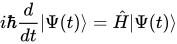
Time-Dependent Schrödinger Equation
The polymath John von Neumann, a contemporary of Schrodinger, believed the physical universe could be made subject to the wave function and first formulated its collapse upon measurement.
∣Ψ⟩ ——measurement——–> ∣ψk⟩
Or in other words, the universe is an immaterial possibility that only manifests into reality when it interacts with an observer and the waveform collapses. Evidence for this came from the double slit experiment where photons (discrete “packets”) of light appear in a diffraction pattern characteristic of a wave That waves of light can be materialised, distilled down from their superpositions when they are perceived by consciousness.
One of the conundrums of the measurement problem is the question of what is doing the measuring? If the observation took place within the universe wouldn’t it also be subject to the same causality. In contemplating the recursive nature of this paradox, von Neumann concluded that the equation could only be solved if the observer was outside the physical universe: only a non physical witness/consciousness could bring the haze of superpositions into focus. But what might that meta observer be?
God does not play dice with the universe.
Einstein (expressing his deep disagreement with quantum mechanics’ probabilistic nature.)
It’s humbling to realise how little our senses perceive and our minds comprehend, and easy to feel insignificant in the context of the universe’s unimaginable size and complexity. I wonder if, like a surfer, we can be the conscious witness to the wave’s final form, albeit for a moment.
The Greek letter Psi is used to denote the wave function.


 Something about boys